




Summary
Modern data centers are under pressure to increase density, reduce energy consumption, and maintain thermal reliability. While containment systems are widely adopted, small gaps and airflow leakage can significantly undermine performance—often going unnoticed until costs rise or hotspots appear. This article explores how Dissolvable Air Barrier (DAB) Panels address these hidden inefficiencies by sealing airflow paths, improving cooling performance, and enabling full containment without compromising fire safety or requiring costly infrastructure changes.
Modern data centers are being asked to do the impossible: push harder, run leaner, and stay cooler. They’re pushing higher rack densities and tighter margins at the same time as keeping energy costs and thermal risks under control.
Within the modern data center, containment design is pretty much standard practice, whether hot aisle or cold aisle. It solves cooling inefficiencies by physically separating airflow paths. However, without proper sealing, hot and cold air mix, pressures drop, and cooling – one of the data centers’ biggest operational costs – doesn’t perform the way it’s supposed to. By the time you realize there’s a problem, the inefficiencies have been compounding for months, resulting in an almost imperceptible degradation of a data center’s efficiency, rising costs, and reduced capacity.
The Invisible Inefficiency
Even small gaps and openings such as missing roof panels over the cold aisle when deploying cold aisle containment or missing above rack panels up to the ceiling for hot aisle containment can undermine the entire system. If left unsealed, cold air tends to find the path of least resistance, bypassing IT equipment entirely. Hot exhaust air recirculates back into intake paths, and cooling systems try to compensate by increasing output.
Even in new-build environments, airflow leakage can be an issue. CFD models might indicate you have containment, but even tiny, often overlooked, installation gaps can create air leakage zones that don’t appear in simulations. It’s the contradiction between expected and actual performance outcomes that can lead to time-consuming troubleshooting.
In mature data centers, the problem can unfold even more gradually. Incremental changes, such as new layouts, additional racks, updated cabling, and partial retrofits, can introduce small gaps over time.
In addition, at times the AHJ (Authority Having Jurisdiction) may not allow a roof system over a cold aisle that shrinks and falls to the ground at high temperatures (during a fire event), and improper overhead sprinkler head locations may also prevent hot aisle containment from being installed up to the ceiling, often resulting in a large 24” openings between the top of the containment and the ceiling.
Across both scenarios, the pattern is consistent: there’s no single failure point, just a steady decline in efficiency, invisible until it shows up in energy bills or as an unexplainable thermal anomaly. Even worse, the symptoms are routinely misread as not having enough cooling. The problem isn’t a lack of cooling — it’s airflow leakage. More output doesn’t fix gaps and containment openings. It just costs more to mask it.
Closing the Gaps
This is where DAB (Dissolvable Air Barrier) panels come in.
DAB panels are modular barrier components. Installed horizontally above cabinets for cold aisles or vertically up to the ceiling for hot aisles, they close openings in aisle containment systems, ensuring a tight, controlled airflow environment.
Despite their dissolvable design, DAB panels remain durable during normal operation, withstanding high static air pressure and maintaining airflow separation where it matters most. These modular panels can easily fit existing or changing infrastructure, reducing installation time and cost.
When properly deployed, they:
• Maintain static pressure within contained aisles,
• Ensure consistent delivery of supply air to server inlets, and
• Prevent thermal short-circuiting
Think of them as the “finishing layer” that turns a partial containment installation into a complete containment implementation performing at optimum energy efficiency.
Fix the Leaks and Performance Shifts
When cooled air precisely reaches server intakes, cooling efficiency improves and temperatures stabilize. The workload on the cooling units is reduced, lowering energy consumption, and temperatures become consistent, allowing the safe deployment of higher-density equipment.
Most significantly, airflow becomes predictable. It becomes easier to model performance and optimize cooling strategies, and, rather than being reactive, operators can proactively avoid the hotspots.
Fire Safety
Containment improvements cannot come at the expense of safety.
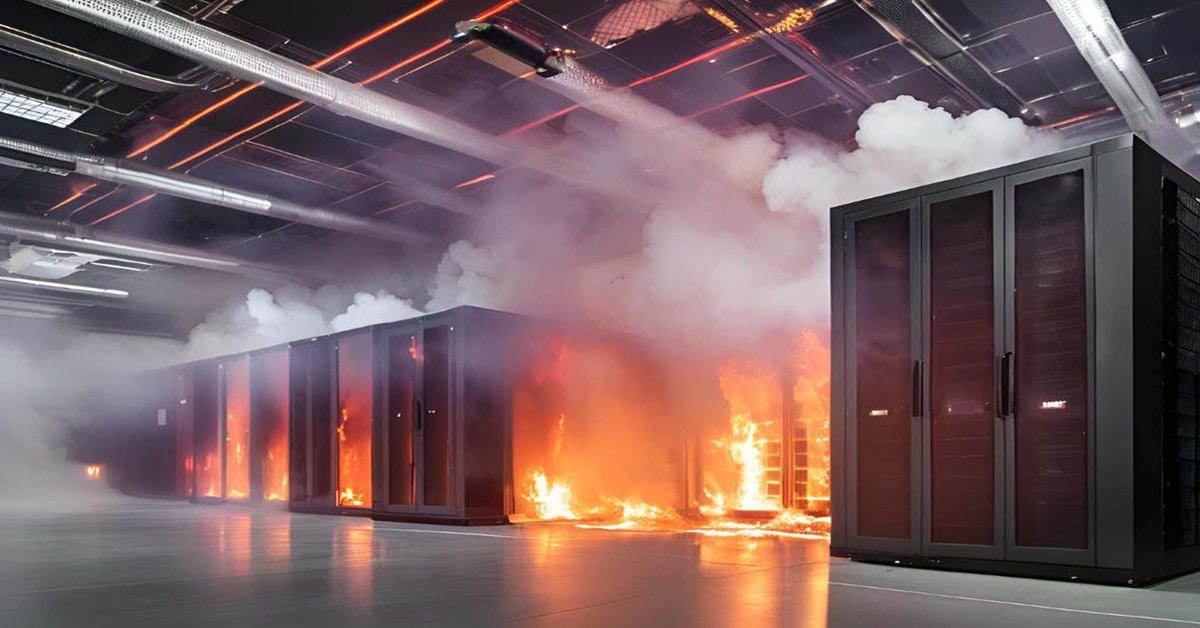
The DAB panel, with its EPA-certified plant-based cellulose material dissolves within seconds when exposed to water during sprinkler activation, eliminating falling panel hazards while producing minimal smoke to maintain visibility for emergency personnel.
In instances where sprinkler head relocation is too expensive to justify installing hot aisle containment up to the ceiling with traditional containment panels, DAB panels easily fill those openings without expensive sprinkler relocation costs. For instances where traditional roof panels are not allowed for cold aisle containment, DAB panels are the easiest and most cost-effective solution.
This is particularly critical in retrofit environments, where compliance risks can be introduced unintentionally. For both cold and hot aisle containment, DAB panels remove the obstacles to complete containment implementation, enabling operators to enhance cooling efficiency without altering sprinkler systems.
Punching Above Their Weight
When required in place of traditional containment for full cold and hot aisle containment deployments, DAB panels aren’t the most visible part of a data center, but they play a critical role in making modern containment strategies deliver on their promise.
In high-density environments, small details can make a big difference. DAB panels are one of those details that punch well above their weight. Containment systems are only as strong as their weakest point, and in most data centers, those are unsealed openings. If you’re investing in containment but ignoring airflow sealing, you’re leaving performance and money on the table.
High-density data centers don’t collapse overnight. They don’t fail because of poor design or a bad component. They fail because of the weakest seal.