

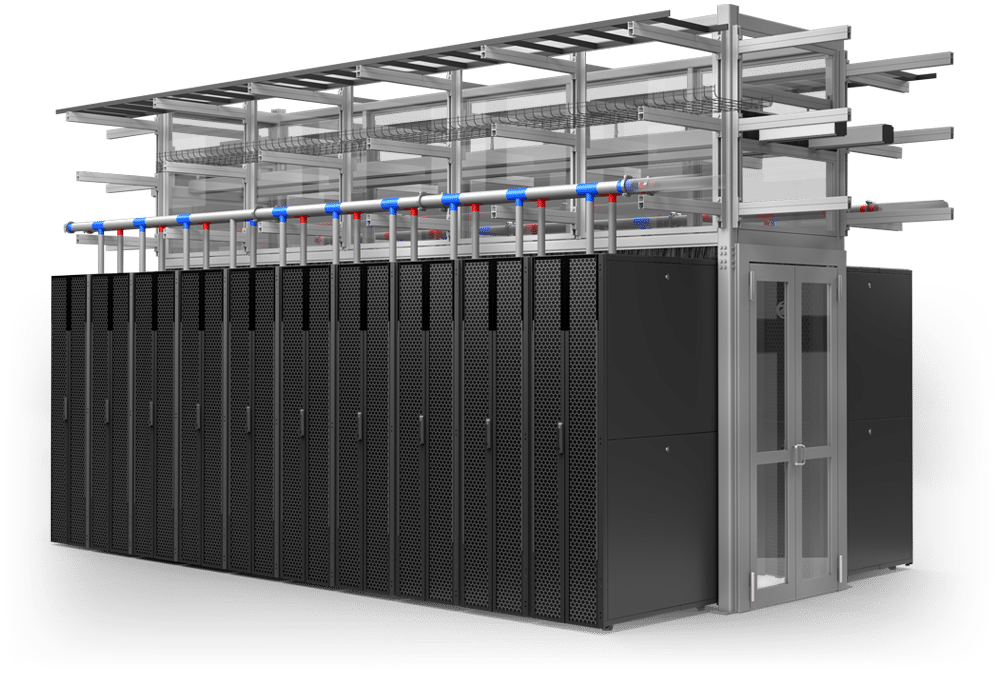
Composite Aisleframe (CAF) – Overview
Traditional steel containment systems carry weight penalties that increase shipping costs, slow installation, and complicate deployments in constrained-access facilities. Manufacturing processes generate significant carbon emissions.
Composite AisleFrame (CAF) addresses these limitations with engineered polyurethane composite construction. The material delivers equivalent structural performance at half the weight. Non-conductive properties eliminate grounding requirements. 100% end-of-life recyclability support ESG initiatives and LEED certification requirements.
Composite AisleFrame (CAF) isn’t a compromise. In multiple performance categories, composite construction outperforms steel while dramatically reducing environmental impact.
Why CAF Exists
Data centers represent approximately 1.5% of global electricity consumption. Infrastructure materials and transportation contribute additional carbon footprint. As the industry scales to support AI workloads and edge computing expansion, material efficiency becomes critical.
CAF development focused on three objectives: reduce carbon footprint across the manufacturing and deployment lifecycle, improve installation efficiency through weight reduction, and maintain structural performance required for data center environments.
The result is containment infrastructure that supports sustainability goals without sacrificing the technical requirements data centers demand.
Performance + Sustainability
CAF delivers measurable advantages over traditional steel frames across operational and environmental metrics.
- Eco-Friendly: Saves up to 4,332 kg per CO2 per frame
Lower weight cuts transportation carbon footprint. 100% recyclability eliminates landfill waste at end of lifecycle.
- Highly Durable
Composite materials resist corrosion, moisture damage, and temperature cycling that degrades steel over time. Extended service life reduces replacement frequency and associated costs.
- Cost Effective: Lower install, transport, and lifecycle costs
Reduced shipping weight cuts transportation expenses. Faster installation reduces labor costs. Extended service life spreads capital investment over longer operational periods.
- Fast Deployment: 2-3 person team installs in half a day
Lighter components simplify handling and positioning. Common tool assembly eliminates specialized equipment requirements. Reduced installation time minimizes disruption to active facilities.
- Flexible Design: Reconfigure as deployments scale
Modular construction adapts to changing infrastructure requirements. Add sections to existing installations. Reconfigure layouts when equipment densities change.
- AI/HPC Ready: Built for liquid-cooled environments
Integrated pathways accommodate direct-to-chip cooling infrastructure. Non-conductive material simplifies liquid cooling installations by eliminating grounding concerns near cooling manifolds.
CAF for Specific Deployment Scenarios

Edge Deployments
Edge facilities often occupy non-traditional spaces with challenging access. Retail locations. Office buildings. Remote installations. CAF’s reduced weight simplifies transportation to sites without loading docks or freight elevators. Two-person installation teams deploy containment without heavy lifting equipment or specialized tools.
Weight reduction matters most at edge. A standard steel frame deployment requiring multiple trucks and installation crews becomes a single-truck delivery with minimal on-site labor when using CAF.

Green Data Centers
LEED certification and ESG reporting require documented carbon footprint reduction. CAF provides quantifiable environmental benefits: 4,332 kg per CO₂ reduction per frame, 100% recyclable materials, VOC-free construction meeting indoor air quality standards.
The material selection supports multiple LEED credit categories: recycled content, regional materials, construction waste management, and low-emitting materials. Documentation packages support certification applications with third-party verified environmental data.

Warehouses & Retrofits with Floor-Only Access
Retrofit projects often face structural limitations. No ceiling grid for overhead attachment. Floor loading constraints that limit steel frame weight. Obstructions blocking traditional installation access.
CAF’s freestanding design works with concrete slab flooring alone. Reduced weight accommodates floor loading restrictions in older facilities. Lighter components navigate tight spaces and doorways that prevent steel frame delivery to installation locations.

Rapid Buildouts & Constrained-Access Facilities
When deployment timelines don’t accommodate weeks of installation labor, CAF delivers. Half-day installation for standard frames means containment infrastructure keeps pace with aggressive equipment deployment schedules.
Facilities with limited construction access benefit from reduced crew requirements and simplified logistics. No heavy equipment staging. No specialized tools. Standard two-person teams complete installations that would require four to six workers with steel frames.
Technical Specifications
Frame Dimensions:
- Height range: 96″ to 144″ (custom heights available)
- Width range: 42″ to 72″ aisle width
- Length: Modular sections from 8′ to custom lengths
Material Properties
- Construction: Polyurethane composite with recycled content
- Weight: 50% lighter than steel equivalent
- Flame rating: Class A per ASTM E84
- Load capacity: Equal to steel frame performance
- Temperature range: -40°F to 180°F
Installation Requirements
- Tools: Standard hand tools only
- Crew size: 2-3 person team
- Installation time: Half day for standard deployment
- Floor preparation: Concrete slab, no raised floor required
- Grounding: Not required (non-conductive material)
Compliance & Certifications
- Seismic: Engineered for high-risk zones
- Fire rating: Meets building code requirements
- VOC content: Zero VOC emissions
- Recyclability: 100% recyclable at end of life
- LEED contribution: Multiple credit categories
Cooling Integration
- Air cooling: Full compatibility with traditional HVAC
- Liquid cooling: Integrated pathways for direct-to-chip systems
- Cable management: Built-in routing for power and data
- Power distribution: Compatible with overhead and under-floor delivery
CAF vs. SAF Comparison
| Feature | Composite AisleFrame (CAF) | Steel AisleFrame (SAF) |
| Material | Polyurethane composite | Steel |
| Weight | 50% lighter | Standard weight |
| Installation Time | Half a day | Full day or more |
| Tools | Standard only | May require special tools |
| Conductivity | Non-conductive | Conductive |
| Grounding Needed | No | Yes |
| Recyclability | 100% | Depends on source |
| Seismic Rating | Equal performance | Equal performance |
| Cooling Compatability | Liquid cooling-ready | Liquid cooling ready |
| Carbon Footprint | 4,332kg CO2 reduction | Baseline |
| Service Life | Long service life | Standard |
| Shipping Efficiency | More frames per truck | Standard |
Frequently Asked Questions
Is CAF as strong as steel?
Yes. Engineered polyurethane composite delivers equivalent structural performance to steel frames in load-bearing capacity and seismic resistance. The material achieves this performance at half the weight through advanced composite engineering rather than mass.
Can CAF help me certify for LEED?
CAF contributes to multiple LEED credit categories including recycled content (MR Credit 4), regional materials (MR Credit 5), construction waste management (MR Credit 2), and low-emitting materials (EQ Credit 4.1). Documentation packages provide third-party verified data supporting certification applications.
Is the material flame-rated or UL listed?
CAF meets Class A flame spread rating per ASTM E84 testing. Material certifications and test reports support building code compliance and permit approval processes.
What are the sustainability benefits of Composite Containment Systems?
Each CAF frame eliminates 4,332 kg CO₂ compared to steel alternatives through three mechanisms: recycled content manufacturing reduces production emissions, reduced weight cuts transportation carbon footprint, and 100% recyclability eliminates landfill waste at end of lifecycle. VOC-free construction meets indoor air quality standards without off-gassing.
Can I use CAF in seismic zones?
Yes. CAF engineers to meet seismic requirements for high-risk zones including California, Japan, and other seismically active regions. Structural calculations and compliance documentation support permit approval in jurisdictions requiring seismic certification.
What is the difference between CAF and FRP (Fiber-Reinforced Polymer)?
Both use composite construction, but material composition and manufacturing processes differ. CAF uses polyurethane composite specifically engineered for data center containment applications with optimized strength-to-weight ratio and thermal properties. FRP typically refers to fiberglass-reinforced materials used in different applications. CAF development focused on data center requirements: structural performance, fire rating, thermal stability, and manufacturing consistency.
Configure & Quote Your Composite AisleFrame (CAF)™ System
Complete the simple configuration questions below to tell us about your infrastructure needs.
Our team will review your submission and personally follow up within 48 hours to discuss AisleFrame solutions tailored to your requirements.